Count the boots you use now
Distinguish current daily boots from occasional or off-season pairs. A small active set may need only a defined place beside the rack, while a large permanent boot collection could justify a different overall storage format.
Check footwear care guidance
Use a storage position appropriate to the boots and their manufacturer’s directions. Do not assume that folding, hanging or pressing them into a lower compartment is suitable merely because it reduces the apparent footprint.
Compare combined floor space
Mark the shoe rack and the boot position together. The rack’s small dimensions do not describe the complete entry arrangement once tall footwear stands beside it, so assess both against the actual route and doorway movement.
Keep the exception bounded
Define how many pairs belong in the boot zone and where seasonal extras go. Without that limit, the space beside the shelf can become another unplanned shoe row that gradually stretches across the entry floor. Review the boot zone when the season changes instead of letting it become year-round overflow.
For example, one active pair of tall boots can stand in a suitable defined place while everyday low shoes use a compact two-level rack nearby.
Continue your research.
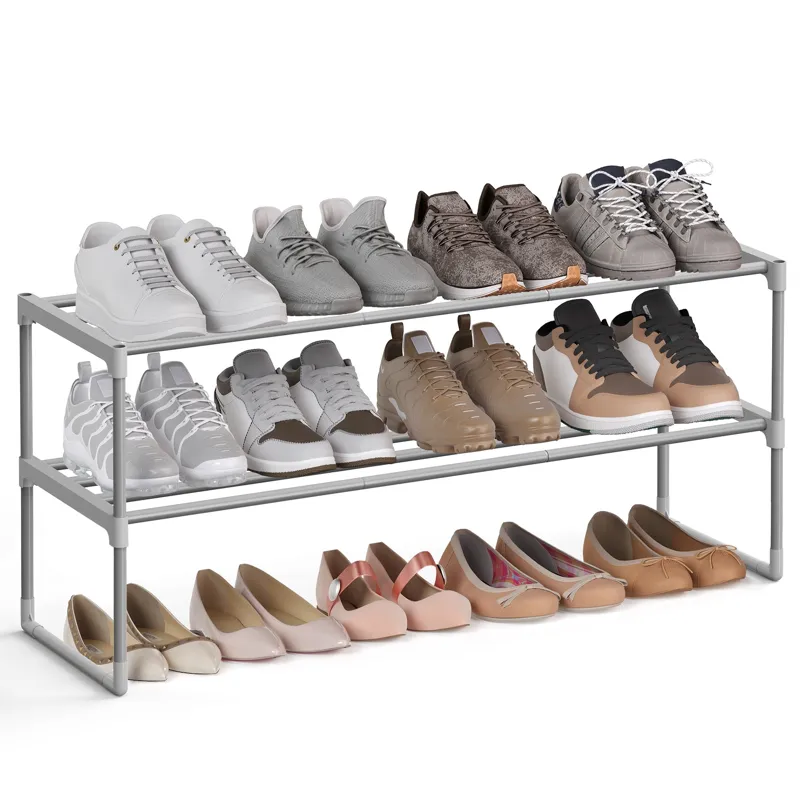
Shoe Rack, 2-Tier Shoe Organizer, Metal Storage Shelf
Check how your footwear fits the usable shelf or compartment dimensions.
Read the existing model research →References & research notes
These references inform the decision process. Numerical examples are illustrative unless explicitly attributed; they are not specifications for the linked products. Product links are examples to investigate, not confirmation that they fit your space. Verify the exact model and its current manufacturer instructions before ordering.
Created with AI assistance and reviewed for internal consistency, source relevance and links. We have not physically tested the featured products. Affiliate disclosure.